
E-scooter-related injuries in the Reykjavík area during the summers of 2023–2025

Introduction
In recent years, electric scooters (e-scooters) have become a popular mode of transportation in the Reykjavík metropolitan area. E-scooters offer an inexpensive, environmentally friendly mode of transportation that many users consider fast and convenient. However, concerns have been raised regarding the associated risk of injury.
A previous study of e-scooter-related injuries in the Reykjavík metropolitan area, conducted in summer 2020, identified 149 individuals who attended the emergency department (ED) at Landspítali University Hospital after e-scooter accidents, averaging 1.6 patients per day during the summer months. Patients ranged in age from 8 to 77 years; 45% were under 18, and 58% were male. In 60% of cases, the reported cause of the accident was excessive speed, loss of balance, or uneven road surfaces. Among patients aged 18 years and older, 40% reported being under the influence of alcohol or other intoxicating substances at the time of the accident. In the study from the summer of 2020, 6% required hospital admission for observation or treatment, but no fatalities were recorded.1
Since that study was conducted, several important developments have occurred. The number of e-scooters in the Reykjavík metropolitan area has increased substantially. The largest e-scooter rental company operated approximately 200 scooters during the summer of 2020, compared with more than 2,000 in the summer of 2025. According to information provided by the City of Reykjavík, the company recorded approximately 200,000 or more rental trips per month. In addition, sales of privately owned e-scooters have remained high, indicating continued growth in this mode of transportation.
Concerns have also increased regarding serious e-scooter-related injuries. Two fatal e-scooter accidents occurred in Reykjavík in 2021 and 2022. Furthermore, considerably more powerful e-scooters have entered the market. Although most e-scooters have motors rated between 250 and 700 W, scooters equipped with motors rated at 5,000 W or more are now known to be in use. Confirmed reports indicate that such scooters are operated at speeds substantially exceeding the statutory maximum of 25 km/h.
Several measures have been introduced to reduce the increasing burden of e-scooter-related injuries. The Icelandic Transport Authority has implemented extensive injury prevention and public education initiatives.2 In July 2024, amendments to the Road Traffic Act No. 77/2019 came into force, making the operation of an e-scooter under the influence of alcohol a criminal offence subject to the same penalties as driving a motor vehicle while intoxicated. The amendments also prohibited children under 13 from operating e-scooters and banned modifications that allow scooters to exceed 25 km/h.3 Evaluating the effects of these preventive measures and legislative changes on injury incidence is therefore important.
Internationally, injuries associated with this relatively new mode of transportation have been extensively investigated. Alcohol intoxication has been identified as a common contributing factor in e-scooter accidents in Oslo, Norway.4 Studies have also demonstrated that facial injuries associated with e-scooter accidents are more frequent and severe than those associated with bicycle accidents.5
In Iceland, external causes of injury are still recorded using the NOMESCO classification system.6 A limitation of this system is that it has not been updated since 2007 and therefore does not permit reliable identification of the nature and extent of injuries associated with this new mode of transportation. The Directorate of Health has decided to discontinue this classification system, and a new injury registration system is under development which will hopefully be up and running soon. To address the limitations of existing injury surveillance, a dedicated electronic medical record form for documenting the circumstances and causes of e-scooter accidents was introduced at the ED of Landspítali University Hospital on 1 June 2023.
This study aimed to assess the incidence, causes, and severity of e-scooter-related injuries in the Reykjavík area during the summers of 2023–2025 and to evaluate changes over the study period.
Materials and Methods
The study was conducted at the emergency department at Landspítali University Hospital. Data were collected using a standardized electronic medical record form designed to document where and how the accident occurred, the number of individuals riding the scooter, and whether the scooter was privately owned or rented. The survey also recorded use of protective equipment, including helmets and wrist, elbow, and knee protectors. An “other“ response option was available for each item. Patients were also asked whether they had been under the influence of alcohol or other intoxicating substances at the time of the accident. A “not reported” response option was also available. Patients completed the registration form themselves, with assistance from ED reception staff when required.
We obtained information on injuries, treatment, and clinical outcomes from the hospital’s electronic medical records. Statistical analyses were performed using MedCalc statistical software (medcalc.org).7 The study was conducted with approval from the National Bioethics Committee and the ethics committee of Landspítali University Hospital.
Results
During the three summer study periods, a total of 513 individuals presented to the ED of Landspítali University Hospital because of e-scooter-related injuries, corresponding to an average of 1.86 patients per day. Of these patients, 349 (68.0%) were male, 164 (32.0%) were female and 44 patients (8.6%) had a foreign identification number.
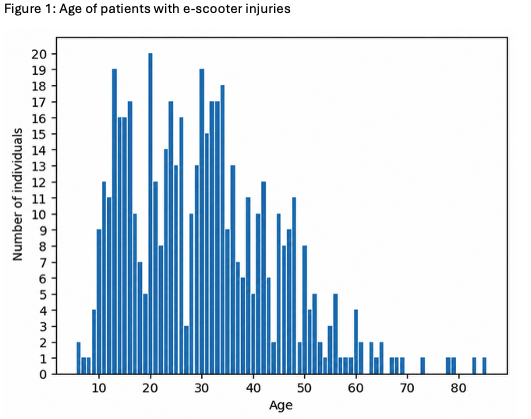
Patients ranged in age from 6 to 85 years, with a mean and median age of 30 years. A total of 118 patients (23%) were aged 17 years or younger, including 91 (18%) aged 6–15 years. Seventeen patients (3.3%) were aged 10 years or younger, and 10 patients were aged 65 years or older (Figure 1).
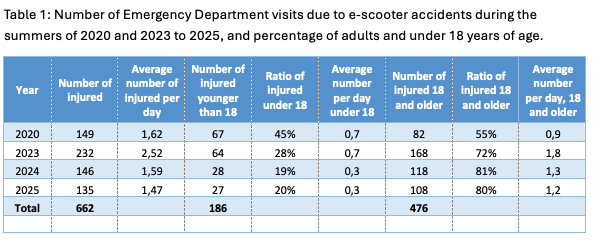
The number of injuries decreased substantially over the study period: in the summer of 2023, 232 patients attended the ED, corresponding to an average of 2.52 patients per day, 146 patients (1.59 per day) in 2024 and 135 patients (1.47 per day) in 2025. The decrease between 2023 and 2024 was statistically significant, with 86 fewer cases (37%; p < 0.001). However, the further decrease of 11 cases (7.5%) between 2024 and 2025 was not statistically significant (p = 0.48).
The greatest reduction occurred among children and adolescents younger than 18 years, for whom the average daily number of injuries decreased by more than half, from 0.7 to 0.3 patients per day. Among children aged 12 years or younger, injuries decreased from 25 in the summer of 2023 to 7 in the summer of 2025.
Injuries among adults aged 18 years and older also decreased from an average of 1.8 to 1.2 patients per day, although the latter figure remained higher than in 2020.
Table 1 presents further details, including comparisons with the 2020 study.
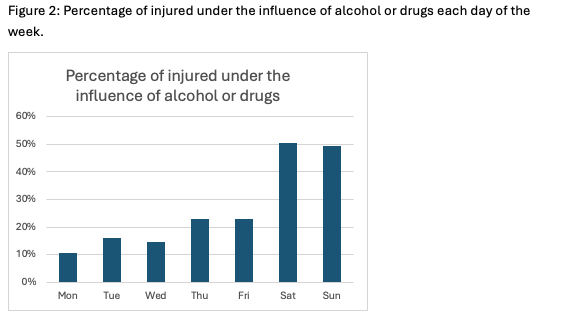
E-scooter accidents were more frequent on weekends than on weekdays. From Monday to Friday, an average of 1.61 accidents occurred per day, compared with 2.46 accidents per day on Saturdays and Sundays. The difference was 0.85 accidents per day (95% confidence interval [CI], 0.50–1.20; p < 0.001). Patients aged 17 years and older were asked about alcohol or other substance use. A total of 138 patients (34%) reported being under the influence of alcohol or other intoxicating substances at the time of the accident. The proportion of accidents involving alcohol or other intoxicating substances decreased insignificantly over the study period, from 35% in 2023 to 34% in 2024 and 32% in 2025. The proportion of patients reporting alcohol or other substance use averaged 17% on weekdays but was significantly higher on weekends, averaging 50% on Saturdays and Sundays (reported p > 0.001). Figure 2 provides a more detailed breakdown.
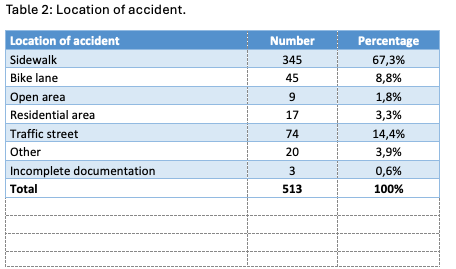
Most accidents involved rental e-scooters, accounting for 333 cases (64.9%). Privately owned e-scooters were involved in 164 cases (32.0%). In 11 cases (2%), the injured individual was not riding an e-scooter; six were pedestrians and three were cyclists. Approximately two-thirds of accidents, 345 cases (67.3%), occurred on sidewalks. Seventy-four accidents (14%) occurred on motor vehicle roads, and 45 (9%) on cycle paths. Other locations were less common. Further details are presented in Table 2.
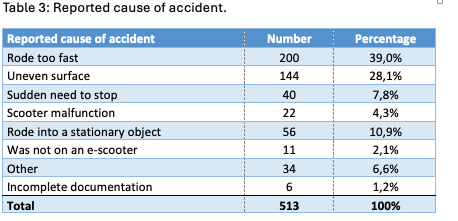
According to patients‘ own assessments, excessive speed contributed to 200 accidents (39%), uneven surfaces to 144 (28%), and collisions with stationary objects to 56 (11%). In 24 cases, a motor vehicle was reported to have struck an e-scooter rider.
Eighty patients (16%) reported wearing a helmet at the time of the accident, whereas 429 (84%) reported not wearing one. Helmet-use data were lacking for four patients. None of the patients reported using other protective equipment. Table 3 provides further details.
Among patients aged 17 years or younger, two individuals had been riding together on the e-scooter in 24 cases (20%), while in two cases three individuals had been riding together. Among the 395 patients aged 18 years or older, 12 (3%) reported riding with another person. No cases involving three riders were recorded in this age group. Information regarding the number of riders was lacking in 10 cases.
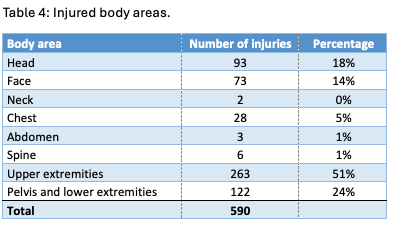
The most common injury location was the upper extremity, affected in 263 cases (51%), the pelvis and lower extremities were injured in 122 cases (24%), and the head and face in 166 cases (32%). Further details are presented in Table 4.
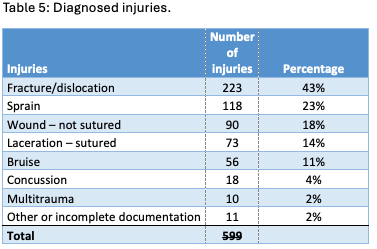
The most frequently recorded injuries were fractures and dislocations, occurring in 223 patients (43.5%). Of these, 142 (27.7% of all patients) involved the upper extremities. Wounds were recorded in 163 patients (31.7%), including 73 (14%) with lacerations requiring suturing. Further details are presented in Table 5.
A total of 27 patients required hospital admission for at least 12 hours, including 16 who remained hospitalized for more than two days. Forty patients (7.8%) required surgical intervention for their injuries. An additional 25 patients had fractures or dislocations requiring reduction in the ED. Overall, 234 patients had injuries requiring referral for further follow-up. Thus a total of 274 patients (53.4%) required healthcare services on two or more occasions as a result of their e-scooter-related injuries.
Discussion
A substantial number of patients attended the ED at Landspítali University Hospital due to e-scooter-related injuries during the three summer study periods. The average daily number of ED visits increased from 1.62 in 2020 to 2.52 in 2023. However, the number of injuries subsequently declined, to an average of 1.47 patients per day in the summer of 2025.
The reduction was more pronounced among children and adolescents than among adults. During the summers of 2023–2025, 23% of injured patients were younger than 18 years, compared with 45% in the summer of 2020. The average daily number of injured children and adolescents decreased by more than half, from 0.7 in 2023 to 0.3 in 2025. The reduction among younger children was particularly notable: in the summer of 2020, 24 children aged 10 years or younger sustained e-scooter-related injuries, compared with a total of 17 children in this age group during the summers of 2023–2025. In July 2024, amendments to the Road Traffic Act prohibited children younger than 13 years from operating e-scooters.3 This legislative change appears to have had an effect, as the number of injured children aged 12 years or younger decreased substantially, from 25 in the summer of 2023 to seven in the summer of 2025.
Accidents involving two or even three individuals riding the same e-scooter continued to occur, accounting for 38 cases (7.4%). This risk-taking behavior was more common among children and adolescents, highlighting the importance of ongoing education regarding the dangers of carrying multiple riders.
A notable finding was the significantly higher incidence of e-scooter accidents on weekends compared with weekdays, together with the substantially greater proportion of weekend accidents associated with alcohol or other substance use. These findings are consistent with those reported in international studies.8 It is also possible that individuals using e-scooters on weekends are less experienced than those who use them regularly for weekday transportation.
Among patients older than 16 years, approximately one-third of accidents involved individuals who reported being under the influence of alcohol or other intoxicating substances. There was no reduction in this proportion during the study period. Alcohol and other substance use therefore remain important contributing factors in a substantial proportion of e-scooter accidents, particularly on weekends. Indeed, such incidents might more appropriately be classified as alcohol- or substance-related accidents rather than as e-scooter accidents.
During the study period, considerable efforts were made to prevent e-scooter injuries through public education and legislative changes. The findings suggest that these preventive measures have been associated with substantial improvements, particularly among children and adolescents, for whom the number of injuries decreased by more than half. It is also possible that the reduction in accidents partly reflects increased familiarity with e-scooters among both riders and other road users. The number of alcohol-related accidents decreased from 61 in the summer of 2023 to 36 in the summer of 2025, although the proportion of accidents associated with alcohol or other substance use remained unchanged. Because the overall number of e-scooter accidents decreased while the proportion associated with alcohol use remained stable, it is plausible that public education and preventive measures had a greater impact than the legislative amendment criminalizing e-scooter operation under the influence of alcohol.
The injuries sustained by patients attending the ED following e-scooter accidents were often clinically significant. More than half of patients required two or more healthcare encounters as a result of their injuries, and 65 underwent an intervention for injury management. Although the present study did not include long-term follow-up, it is likely that a substantial number of patients will experience persistent pain, disfigurement, or a functional impairment of some sort resulting from their injuries.
According to information provided by the City of Reykjavík, slightly more than two million rental e-scooter trips were undertaken in the Reykjavík metropolitan area during the summer months covered by the study. During this period, 333 patients attended the ED following accidents involving rental e-scooters. These figures suggest that approximately one in every 6,000 rental e-scooter trips led to an ED visit. A more detailed examination of injury incidence indicates that the rate was lower in the summer of 2025 than in the summer of 2020, despite the number of rental e-scooter trips having probably doubled between these years. This suggests that preventive measures and public education may be contributing to improved safety, together with increasing familiarity with e-scooters among riders and other road users. These findings are consistent with international studies reporting a general decline in e-scooter injury rates relative to the number of trips and suggesting beneficial effects of preventive measures.9,10
The injury incidence associated with e-scooters must also be considered in the context of other modes of transportation. The risk of injury when travelling by e-scooter is substantially higher than that associated with travelling by car. However, transportation choices have important public health implications beyond injury risk. Motor vehicle use contributes to global warming through greenhouse gas emissions and is associated with considerable economic costs and harmful air pollution. Furthermore, car travel does not provide the physical activity associated with active modes of transportation. The proportion of journeys made by private car in the Reykjavík area is likely among the highest in Europe. Increasing the use of active transportation could therefore provide substantial public health benefits for the region‘s population.
In this context, increased e-scooter use has been suggested as a potential means of improving public health. However, e-scooters can hardly be classified as a form of active transportation. Riders generally remain standing and do not use their own energy to propel the vehicle. Consequently, e-scooter travel involves less physical activity than walking or cycling.11
Given the continuing burden of e-scooter-related injuries, authorities should consider measures to limit the number of e-scooters in use. Greater emphasis on electric bicycles as an environmentally friendly mode of transportation could potentially achieve similar reductions in air pollution and private car use while promoting physical activity and reducing injury risk. Utility cycling is generally recognized as a safe mode of travel, with lower injury rates than e-scooter use. (10)
A limiting factor in this study is that included only patients who attended the ED of Landspítali University Hospital following e-scooter-related accidents. It is likely that individuals sustaining minor wounds, sprains, head injuries, or other less severe injuries may not have sought medical attention or may have attended primary care facilities instead. Nevertheless, it is reasonable to assume that all individuals sustaining significant injuries in the hospital‘s catchment area would have attended the ED, suggesting that the study captures all the more serious cases. E-scooters are also used outside the Reykjavík area, and some accidents included in the study may have occurred outside the hospital‘s principal catchment area. Information regarding accident mechanisms was based entirely on patients‘ own assessments rather than formal investigations at the accident scene. Additionally, some patients may not have disclosed alcohol or other substance use at the time of the accident. Finally, injury coding was incomplete with respect to secondary diagnoses. For example, a patient sustaining both a fracture and a superficial abrasion may have had only the fracture recorded. Similarly, injuries affecting both extremities may not always have been coded separately. Consequently, some injuries, particularly minor injuries, were probably underreported.
The current system for recording external causes of injury in Iceland urgently requires revision. The NOMESCO classification system does not allow reliable identification of injury incidence associated with newer transportation modes such as e-scooters. The present study demonstrates that a simple addition to electronic medical record documentation can provide valuable information on injury mechanisms and circumstances that would not otherwise be captured through the NOMESCO system. A new injury registration interface is currently being developed under the direction of the Directorate of Health, and completion of this work should be prioritized.
E-scooter-related injuries remain a significant public health concern, with an average of nearly two patients per day attending the ED of Landspítali University Hospital during the summer months. Nevertheless, injury incidence has declined in recent years, particularly among children and adolescents. Alcohol use continues to contribute substantially to e-scooter-related accidents, especially on weekends. Public education and injury prevention initiatives appear to be associated with improved e-scooter safety in Iceland, and continued efforts in this area are warranted.
Acknowledgements
The authors thank the Emergency Department reception staff at Landspítali University Hospital for their assistance with data registration in the electronic medical records.
Sigrún Guðný Pétursdóttir
Natan Freyr Guðmundsson
Höskuldur Rúnar Guðjónsson
Magnús Ársælsson
References
1. Petursdottir SG, Kristjansson JM, Bjornsson HM. Emergency department visits in Reykjavik for electric scooter related injuries during the summer of 2020. [AY6] [HB7] Laeknabladid. 2021;107(5):234–238.
2. Samgöngustofa/Icelandic Transport Authority. Ekki skúta upp á bak. Available from: https://www.uppabak.is.
3. Lög um breytingu á umferðarlögum, nr. 77/2019. (Road Traffic Act, amended 2024).
4. Stray AV, Siverts H, Melhuus K, Enger M, Galteland P, Næss I, et al. Characteristics of electric scooter and bicycle injuries after introduction of electric scooter rentals in Oslo, Norway. JAMA Netw Open. 2022;5(8):e2226701.
5. Grill FD, Roth C, Zyskowski M, Fichter A, Kollmuss M, Stimmer H, et al. E-scooter-related craniomaxillofacial injuries compared with bicycle-related injuries: A retrospective study. J Craniomaxillofac Surg. 2022;50(9):738–744.
6. NOMESCO. NOMESCO Classification of External Causes of Injuries. Fourth revised edition. 2007.
7. MedCalc Software Ltd. MedCalc statistical software. 2025. Available from: https://www.medcalc.org.
8. Hartz F, Zehnder P, Resch T, Römmermann G, Hartmann V, Schwarz M, et al. Characteristics of e-scooter and bicycle injuries at a university hospital in a large German city: A one-year analysis. Inj Epidemiol. 2025;12(1):2.
9. Vasara H, Toppari L, Harjola VP, Virtanen K, Castrén M, Kobylin A. Characteristics and costs of electric scooter injuries in Helsinki: A retrospective cohort study. Scand J Trauma Resusc Emerg Med. 2022;30(1):57.
10. Seitakari L, Pakarinen O, Harjola VP, Castrén M, Vasara H. Comparing the characteristics of electric scooter and bicycle injuries: A retrospective cohort study. Sci Rep. 2025;15(1):27599.
11. Payne C, Smith SA, Sappal A, Boorgula R, Taylor KA. Are e-scooters active transport? Measured physical activity outputs of e-scooter riding vs walking. J Transp Health. 2025;41:101963.